By Zoë Keens, CfSA Board member and NATRE representative
As a Board member of the Council for Subject Associations (CfSA), I have long been aware of the scale and significance of the work that Subject Associations do. Much of it happens quietly, persistently, and without the recognition it deserves – yet it underpins the professional life of teachers and the health of curriculum subjects across our education system.
The idea for the CfSA Directory did not begin as a formal project. It began with listening.
At a CfSA meeting, we heard from a speaker reflecting on her journey into teaching. She had left a commercial role, raised the money to fund her PGCE, and entered the profession with real commitment. She joined a primary school alongside three other newly qualified teachers. The work was demanding, the expectations high, and after eighteen months she was the last of the four to leave teaching altogether.
What struck me most was not simply the workload – challenging though that undoubtedly was – but her sense of uncertainty and isolation. She spoke about not really knowing what she was doing, not knowing who to talk to, and not being sure where subject-specific guidance might come from. To add to this, she had been made Subject Lead for Religious Education.
When I asked whether anyone had told her about NATRE – the National Association of Teachers of Religious Education – she said she had never heard of it. I mentioned NATRE’s Help, I’m the RE Subject Leader course, and her response has stayed with me ever since:
“If I’d known about that, I probably wouldn’t have left teaching.”
That moment broke my heart. Not simply because of what it said about one individual experience, but because of what it revealed about a wider, systemic issue. Subject associations exist precisely to offer professional community, subject expertise, and sustained support – yet too often they remain invisible to those who would benefit from them most. We cannot afford to lose talented, committed people who enter teaching with hope and purpose, only to find that the reality quickly shatters the rose-tinted glasses. Bursaries may help teachers into the profession, but they do not keep them there. A community of professional support, shared expertise, and subject belonging just might.
Our education system needs to do more than recruit teachers – it needs to support, develop, equip, inspire, and sustain them, especially in those fragile early years.
Subject Associations exist for them; they do phenomenal work on behalf of their subjects and the teachers who teach them at every stage of their career. They keep abreast of Ofsted frameworks and inspection requirements. They monitor the constant shifts and turns of government policy and are first responders. They hold deep subject knowledge and pedagogical expertise. They provide curriculum thinking, professional learning, research-informed guidance, and subject-specific CPD. Many advocate and lobby on behalf of their subject communities at a national level, including in Parliament.
Importantly, Subject Associations are charitable bodies. Many have been working for decades – in some cases for hundreds of years – contributing not only to contemporary debate, but to the very foundations of the curriculum subjects taught in schools today. They carry institutional memory as well as professional insight. They do not chase trends – they sustain disciplines.
And yet, too often, teachers encounter them late – or not at all.
This was the point at which I realised that the problem was not the quality of Subject Associations, but their visibility.
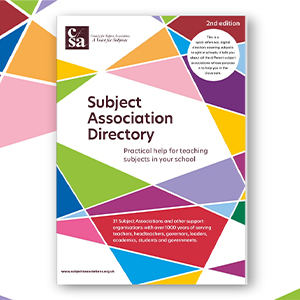
The CfSA Directory was created to address this gap. It leads with curriculum subjects, not organisational names, making it easier for teachers, student teachers, and others working in education to find the subject association connected to their discipline. What began as a free, downloadable resource has now reached version 3 and is used far more widely than originally anticipated – including by policymakers and in Parliament.
The Directory is not a marketing tool. It is a signposting tool – one that recognises the collective contribution of Subject Associations and seeks to make that contribution more visible and more accessible.
My hope is that it becomes a normal part of the professional conversation around teaching subjects – particularly for those early in their careers or newly carrying responsibility for a subject. Not as an optional extra, but as a reminder that no teacher should have to navigate subject expertise alone.
If we care about subjects, we must care about the organisations that sustain them. Subject Associations matter – to teachers, to curriculum integrity, and to the long-term health of education. They always have. Download your free CfSA Directory here: www.subjectassociations.org.uk/the-cfsa-directory/
It is time we talked about that more clearly.